George Hume Brooks
An early pioneer of deaf community photography
George Hume Brooks (1878-1936) lovingly documented his British deaf community. After disappearing into obscurity for several decades, his work deserves a wider audience writes Stephen Iliffe.
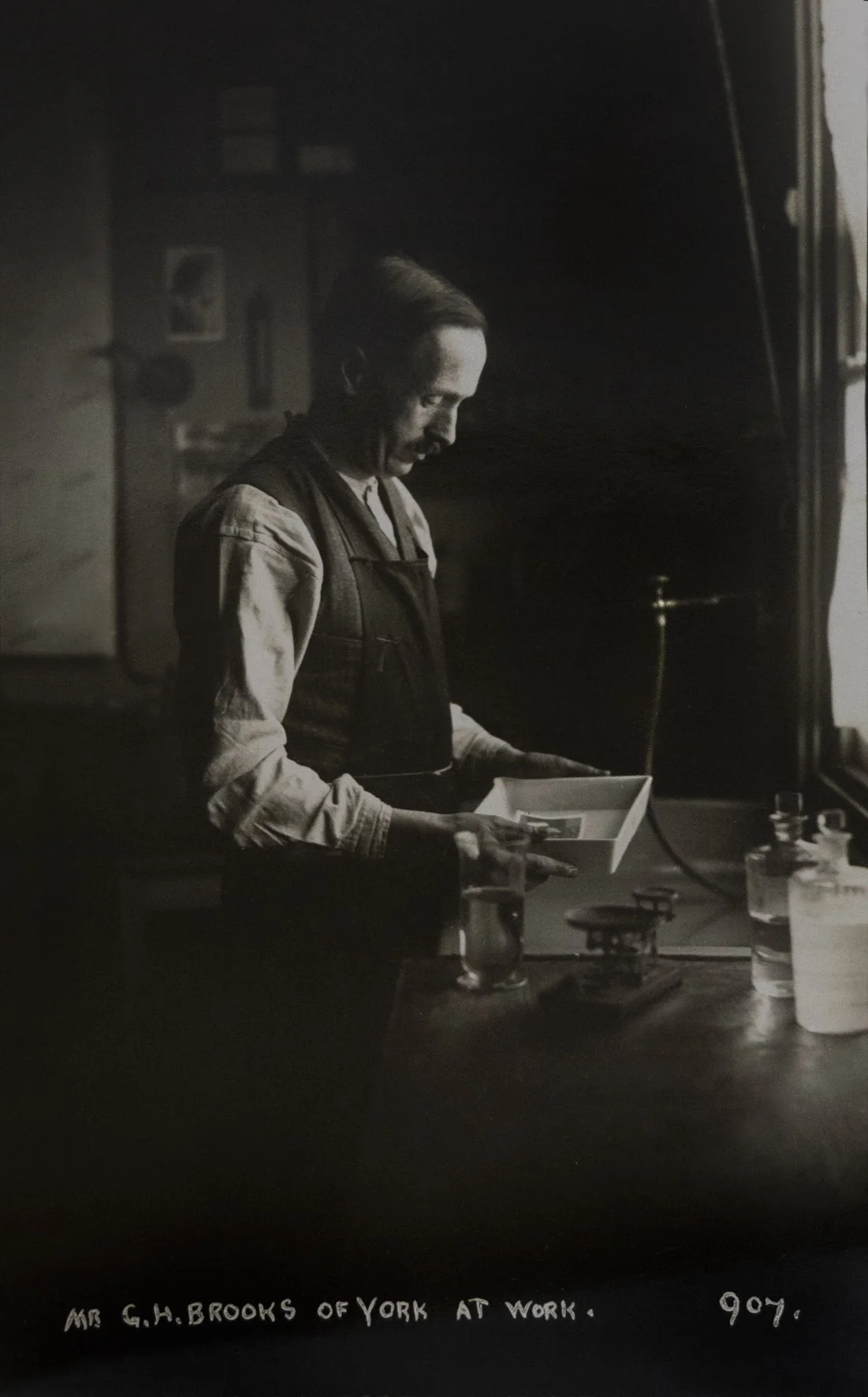
George in his printing studio at 11 Leake Street, York.
In 2024, I visited The Photographer’s Gallery exhibition based on Phillip Prodger’s superb book An Alternative History of Photography. This was inclusive of photographers usually left out of the established histories – women, people of colour, colonised nations.
Yet I was struck by the absence of deaf photographers. Even the alternative histories overlook us. So I asked myself where are they? Did they even exist?
After two years of archival digs they’ve begun to emerge. I’ve found ten so far. One of the most exciting for me is George Hume Brooks.
Between World War One and Two, George’s prolific work affords us a rare glimpse into the lives of deaf people - at home, at school, at work, in public spaces.
Working class beginnings
Born in 1878 into a Rotherham working class family, George became deaf aged three. He was educated at Doncaster’s Yorkshire Institution for the Deaf and Dumb. On leaving school, he followed in his father’s footsteps as a cabinet maker.
Around 1919, when George was in his early 40s, he seems to have taken the plunge to become a working photographer.
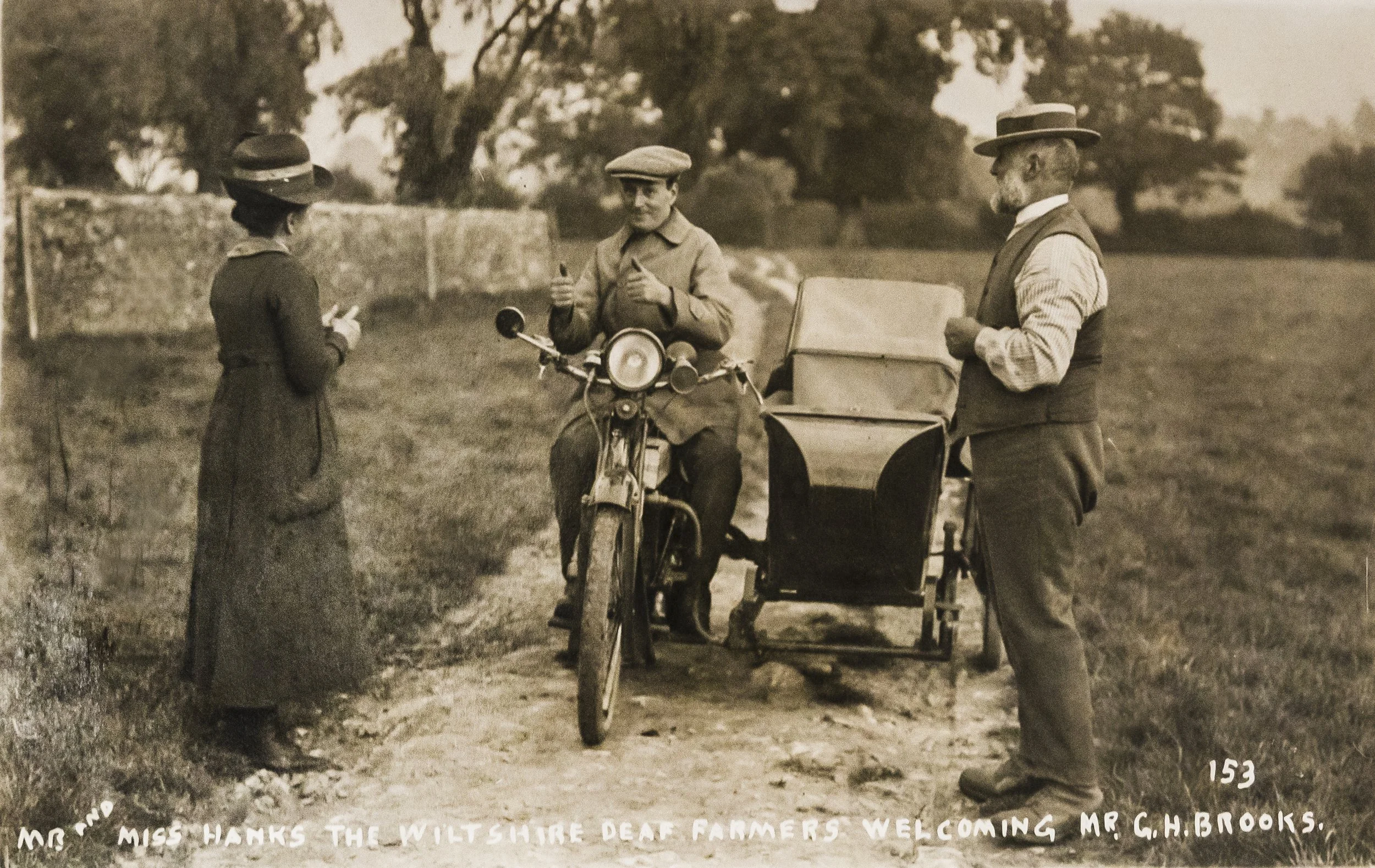
Wiltshire deaf farmers Mr and Miss Hanks welcome George on his motorcycle.
By investing in a powerful Triumph SD 550cc motorcycle with a sturdy Gloria sidecar, George could roam long distances. From Plymouth to Dundee, from Hull to Norfolk, he visited the major deaf communities while also reaching out to isolated rural deaf people. His sidecar transported his large-format camera and accessories.
To get an idea of George’s sheer chutzpah, the above photo shows him being greeted by Mr and Miss Hanks, deaf farmers in Wiltshire. To get there from his York studio, he rode 185-miles for around 10-12 hours (until 1930, the national speed limit was 20mph and the roads were bumpier too).
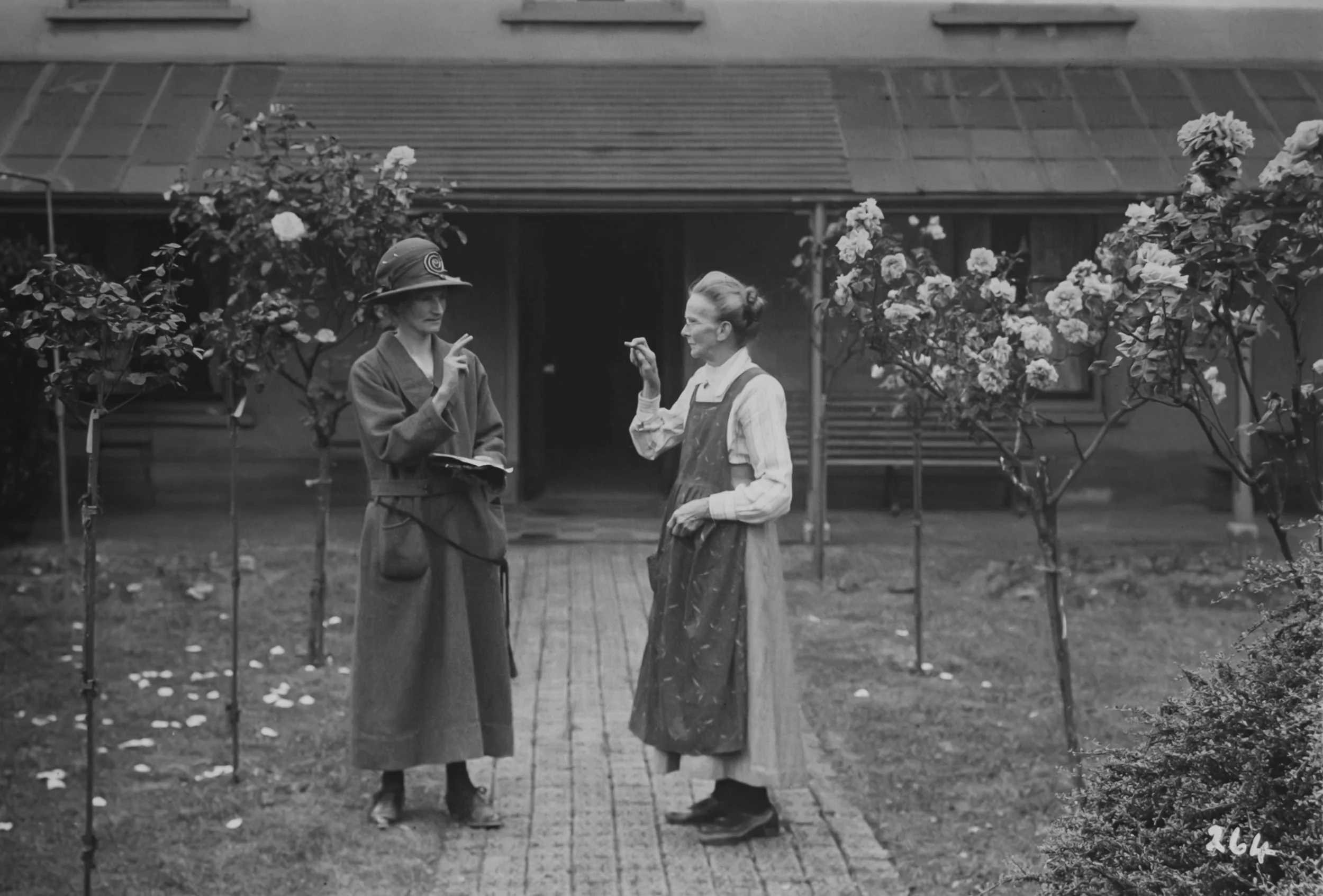
Two women signing in a rose garden.
It’s quite rare in vintage photographs to see deaf people using British Sign Language (BSL). Until the 1980s, BSL was dismissed by hearing society as ‘monkey gestures’ and beneath the dignity of spoken and written English. Many deaf people grew up to internalise these prejudices and avoided being seen to use it in public.
But the above photo shows an intimate moment between two signing ladies in a rose garden. Through George’s eyes, it becomes a sincere and heartfelt observation of his beloved community’s natural language.
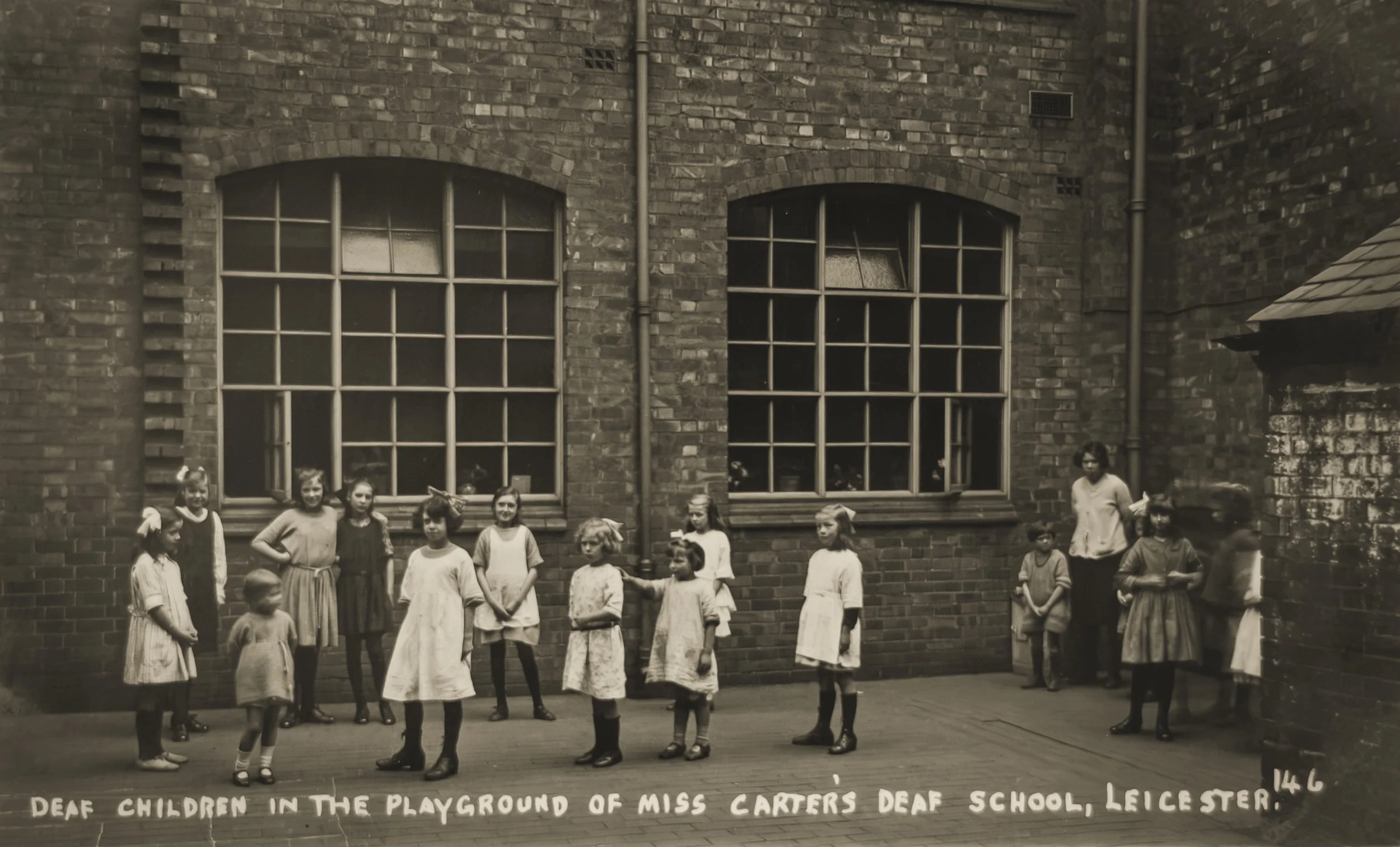
Deaf children in the playground of Miss Carter’s Deaf School, Leicester.
In many cases, George’s photos are the only visual documentation we have of certain historically significant places, such as Miss Carter’s Deaf School in Leicester.
We can only speculate how George awkwardly navigated this visit as Miss Carter’s School was strictly ‘oralist’ and the children forbidden to sign. Did he have to placate the teachers by using only basic pointing gestures to compose the pupils for this picture?
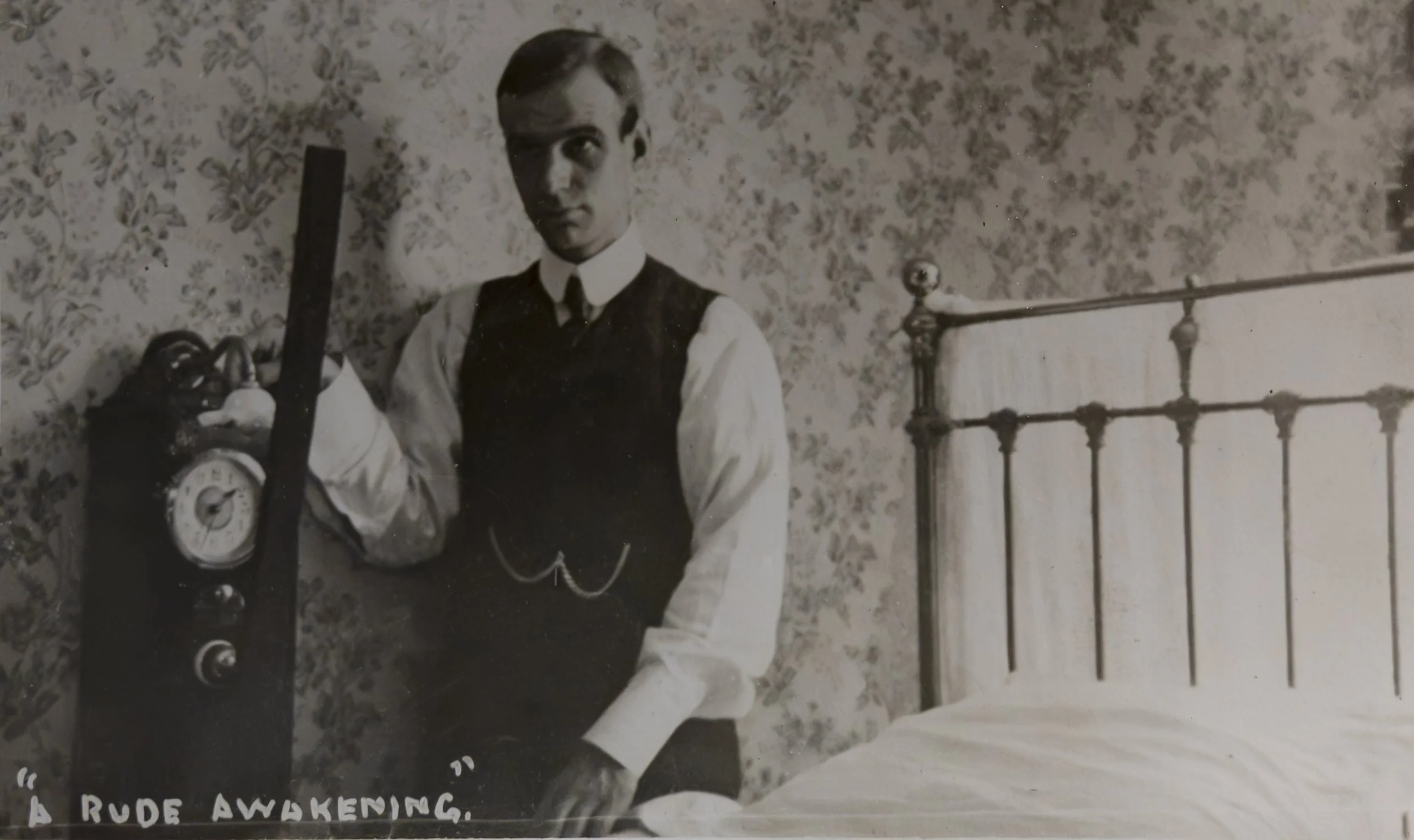
William Layzell, deaf inventor of prototype alarm clock, Newington, Surrey.
Most of George’s work today survives in the form of cheaply-printed postcards archived by the University College London Library. Between the Wars, amateur photographers could take their negatives to a local shop that would print them onto photographic paper with a simple postcard template on the reverse.
These postcards introduce us to some interesting deaf characters. Cabinet maker Walter Layzell of Surrey had a sideline as a product inventor. In this case, an eccentric alarm clock triggers a vertical wooden plank to fall on the sleeping owner. George displays a wry sense of humour by captioning it: “A RUDE AWAKENING”.
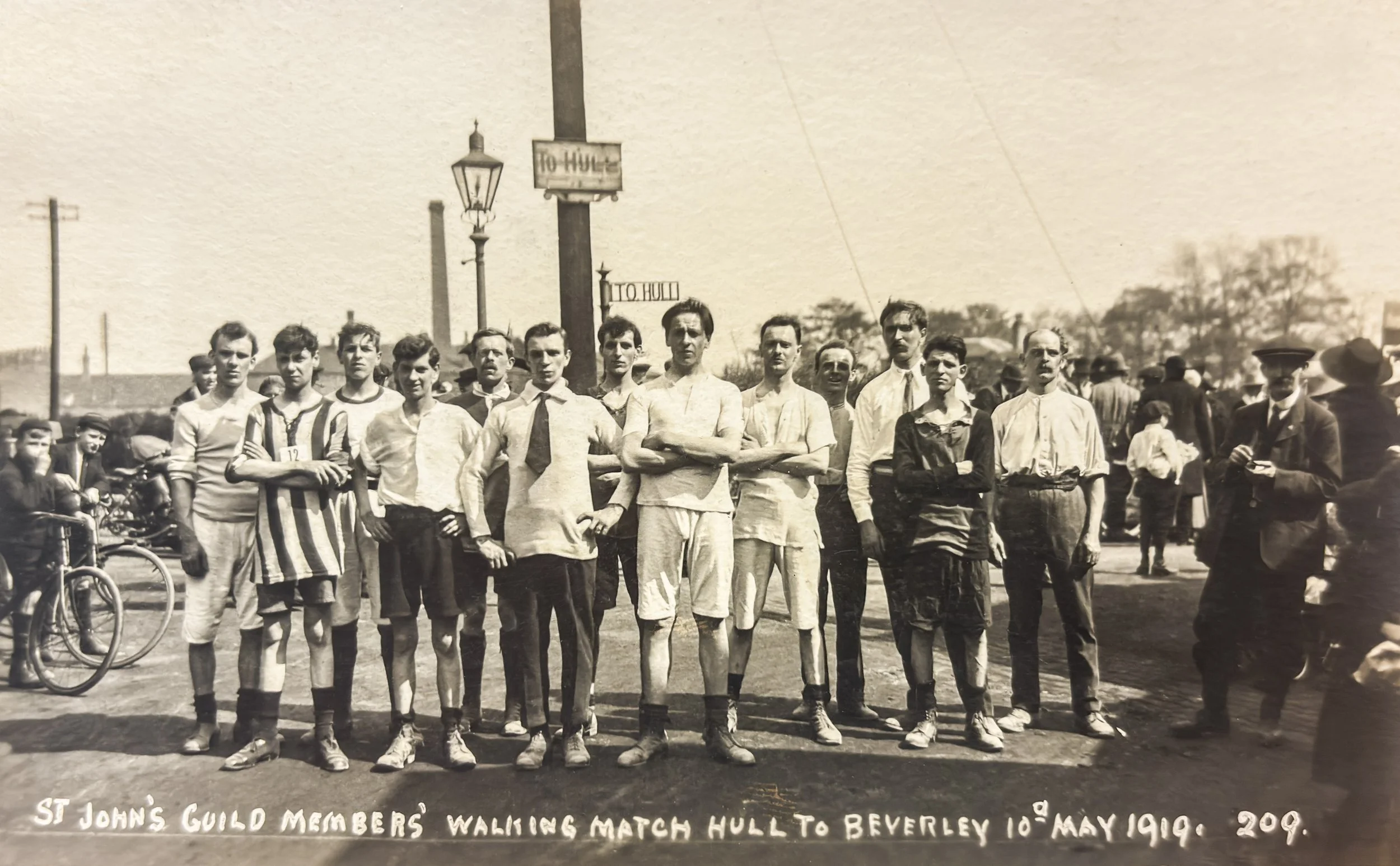
St John’s Guild Members Walking March, Hull to Beverley, May 1919.
After World War One, sports and leisure became a major part of deaf community life. Here, 13 Yorkshire deaf men pause during their 8-10 mile walk from Hull to Beverley. One wears full football kit, some are in walking shorts, amusingly others have donned a shirt and tie.
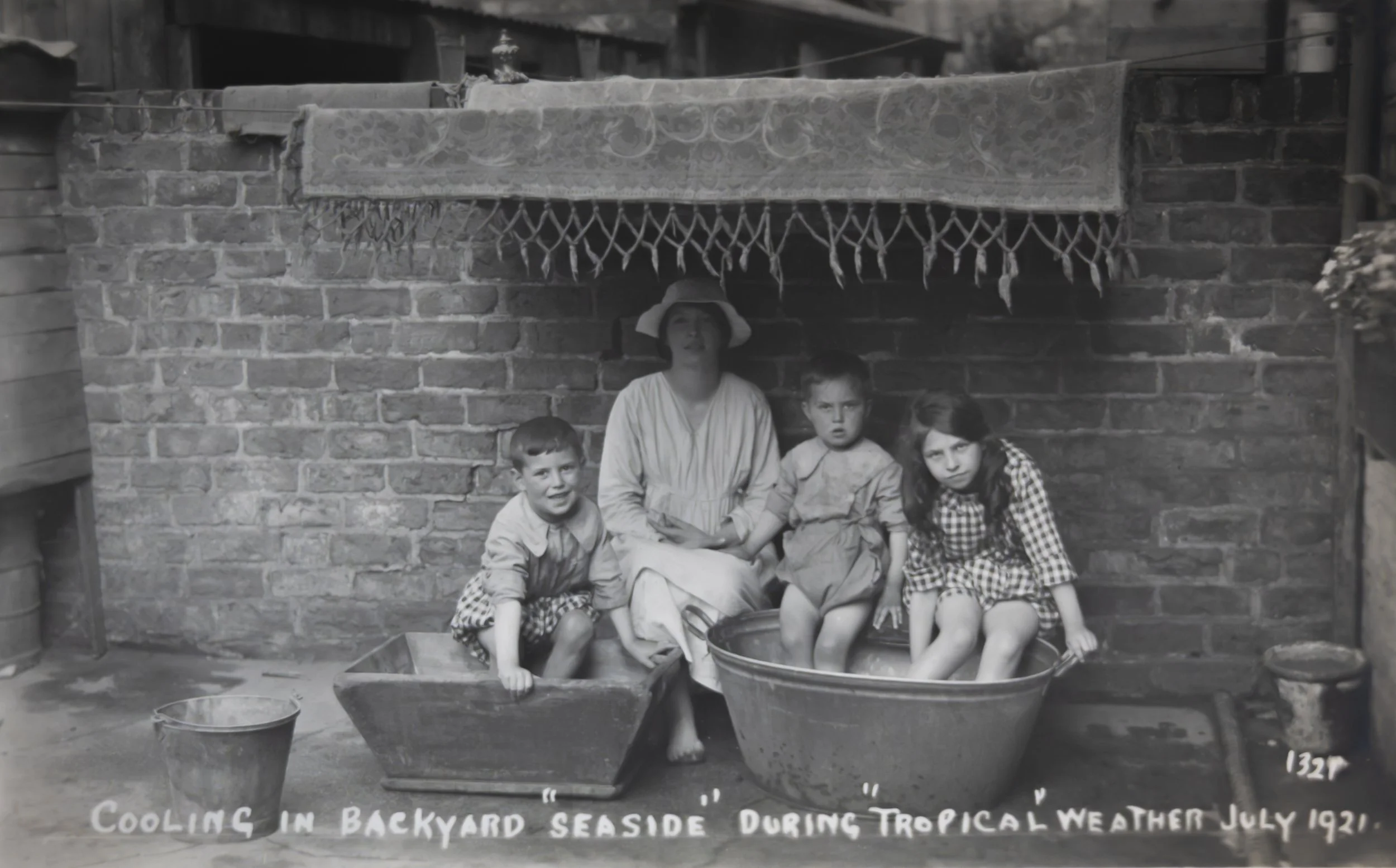
Cooling off in a backyard “seaside” during “tropical” weather, July 1921.
As a deaf photographer, George was able to relax his deaf sitters to compose intimate portraits. In this lovely example, a mother with three children in a backyard. During the great 1921 heatwave, one of Britain’s hottest and driest summers on record, they cool off in a tin bath and earthenware pot.
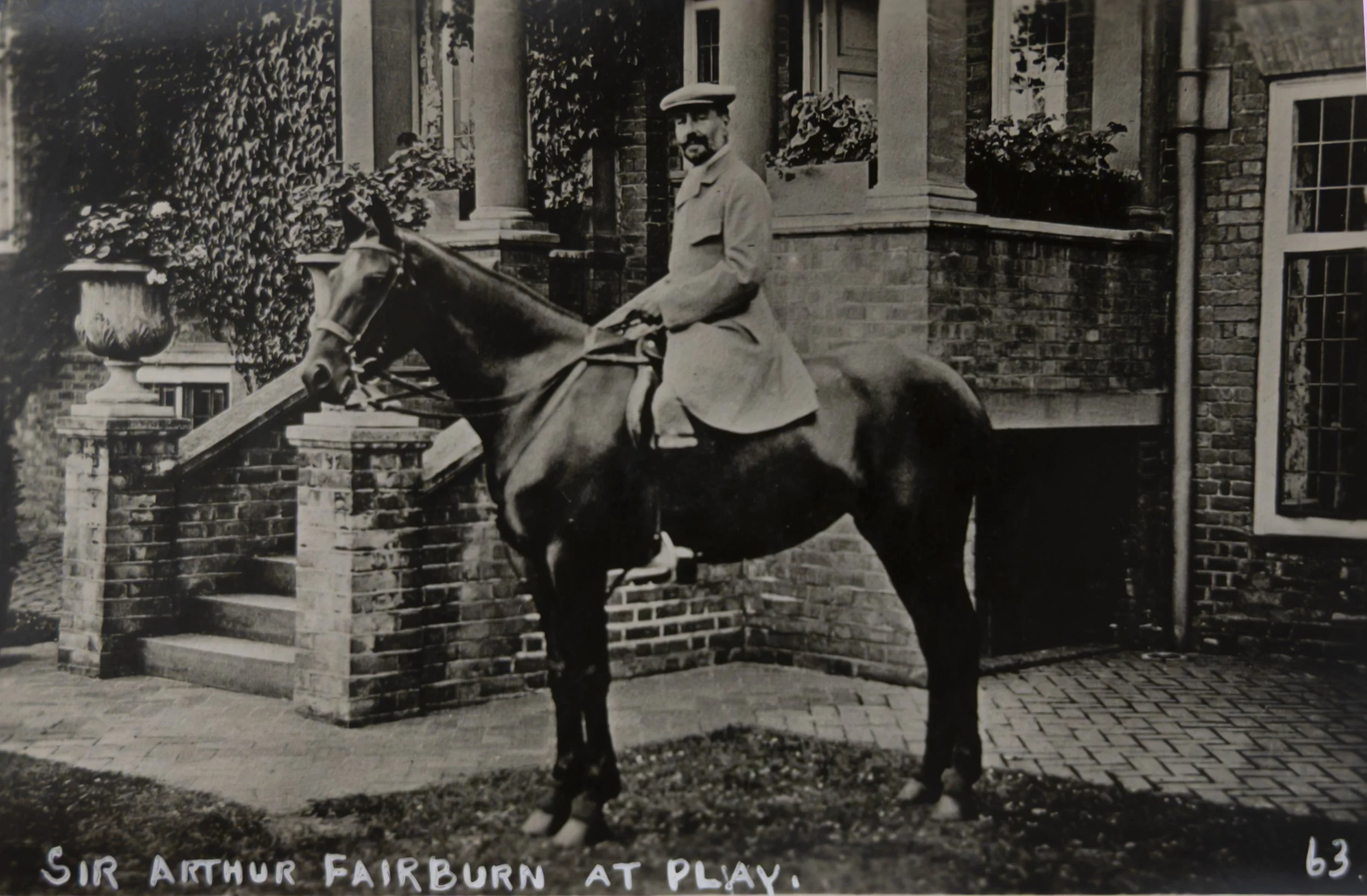
Sir Arthur Fairburn and horse, Sussex
Form the working class to aristocrats, George’s was clearly at ease with deaf people of all social classes. Sir Arthur Fairburn, often referred to as ‘the only deaf and dumb baronet in the world’, sits astride his horse outside a Sussex country house. Arthur was a major benefactor of deaf causes around the country and a firm believer in sign language.
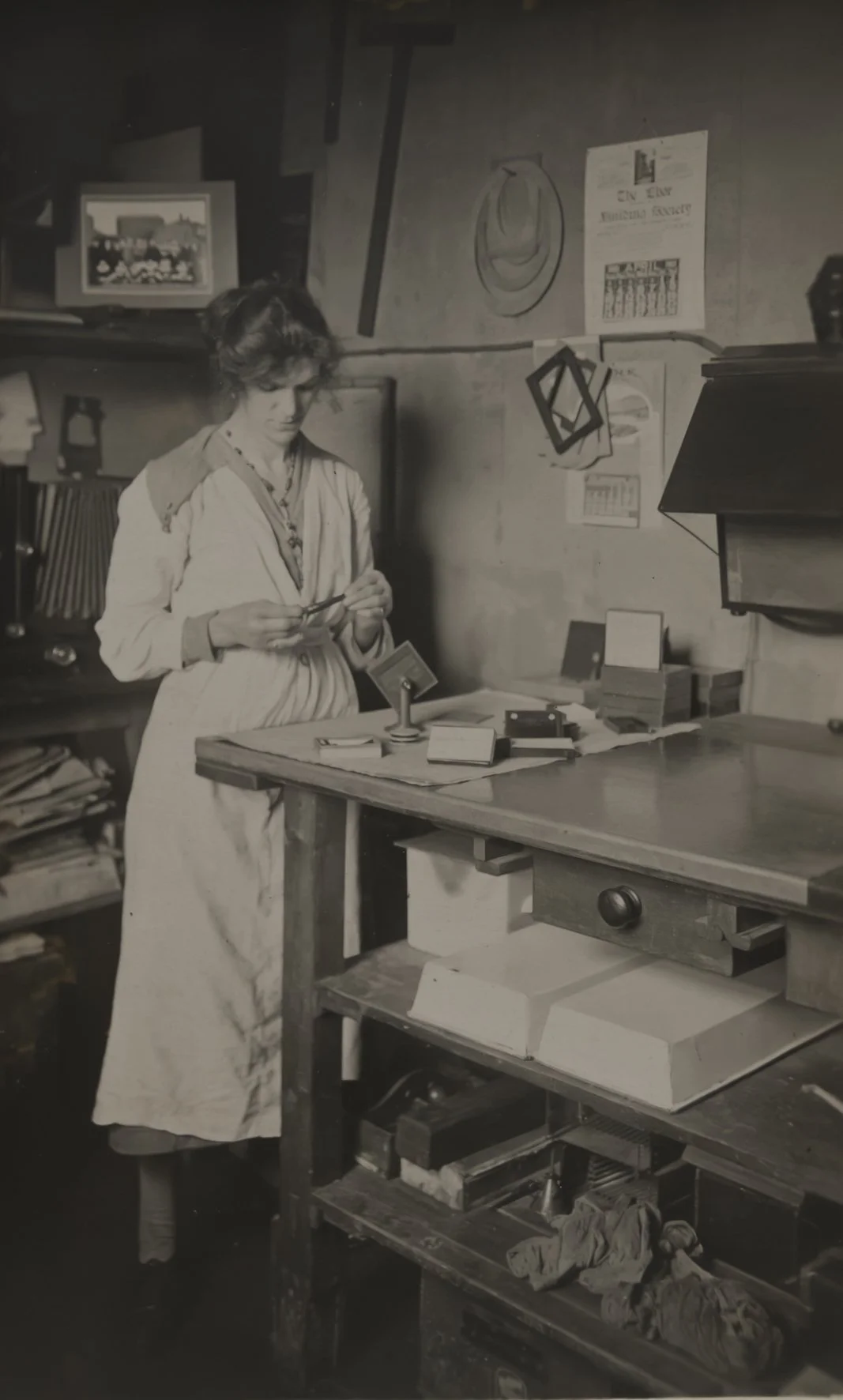
Miss Hunt at George Brooks’ print studio, Leake Street, York
At one point, George employed a local Yorkshire deaf woman - who appears to be Leeds-born Ada Hunt - as his assistant. She is seen here preparing the slides used to make George’s prints. We glimpse George’s large-plate bellows camera to the left, slide boxes on the table, developing trays on the shelves. This was self-empowerment; deaf people creating work opportunities for other deaf people.
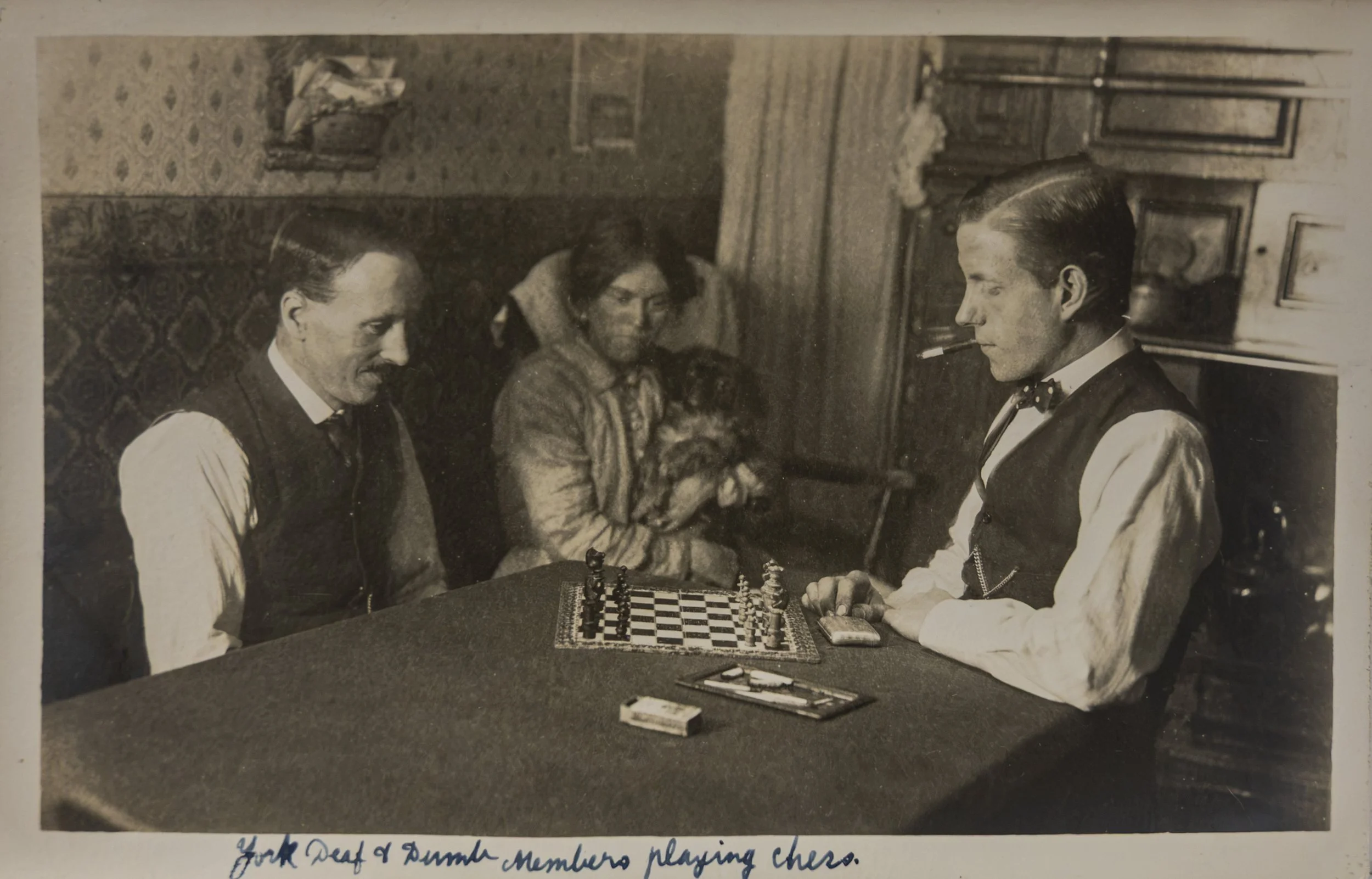
George plays chess at the York Deaf and Dumb Institute social club.
George’s photographs of deaf people have an authenticity and integrity because he was not simply a hearing ‘tourist’ making photographs of ‘deaf and dumb’ people. To his local deaf community he was ‘one of us’. A regular at the York Deaf institute where he and his wife Mary were committee members. Here we see George socialising and playing chess. He ventured into intimate deaf spaces that hearing photographers never looked into.
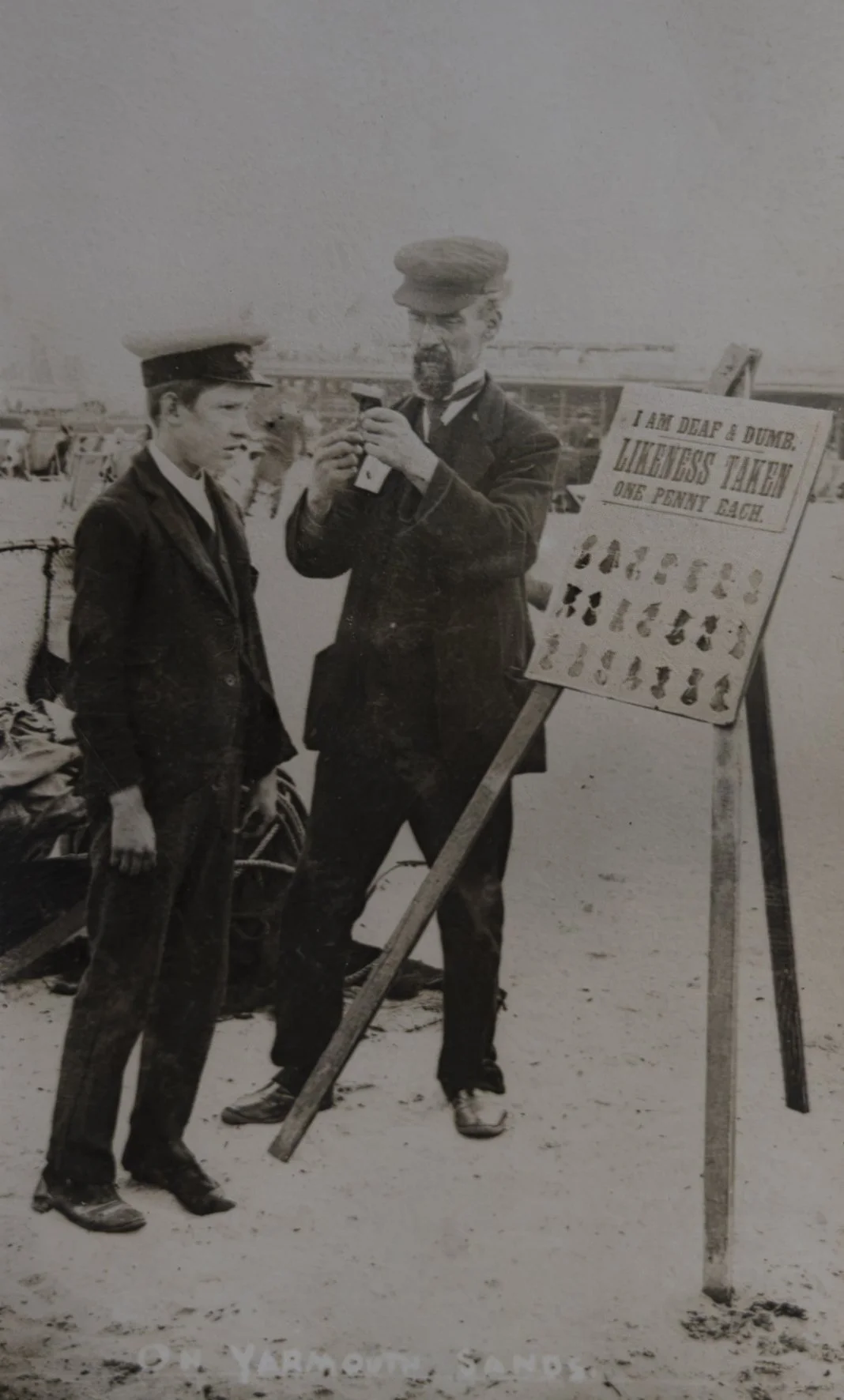
Philip Goodwin, deaf silhouette artist, Yarmouth Sands, Norfolk
How did George find so many interesting deaf subjects in distant locations? His early mentor was Selwyn Oxley, a pioneering missioner who used a touring caravan to host events to empower local deaf people. Oxley encouraged George to join in and photograph these.
The deaf grass roots
And, George had his own grass roots networks too. I love the above one from the east Norfolk coastline of the silhouettist Philip Goodwin. For one penny, he wielded scissors and black paper to deftly cut out the likenesses of passersby.
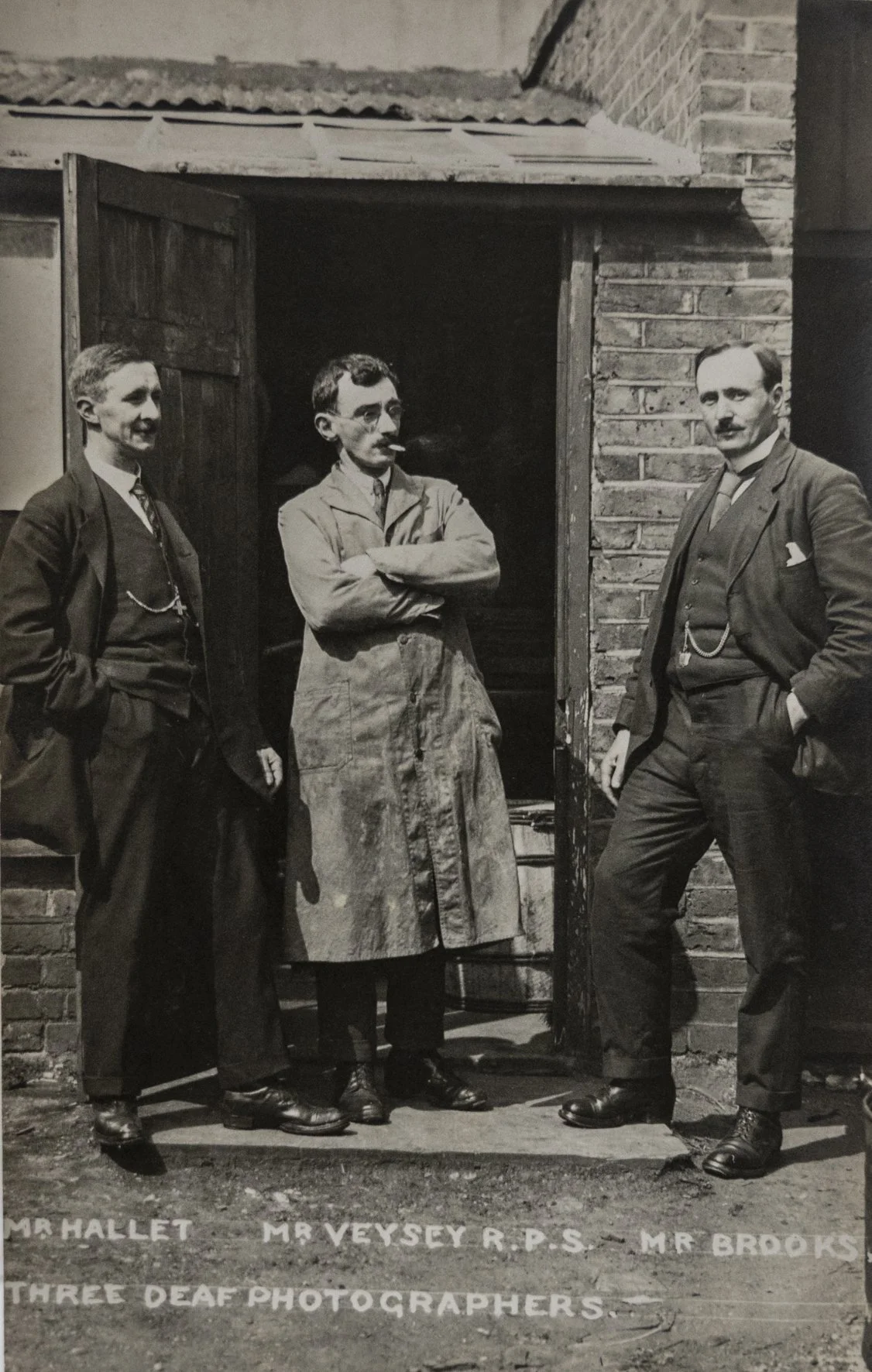
Hallet, Veysey, Brooks - Three deaf photographers outside Veysey’s studio
By the 1930s, there were at least five known working British deaf photographers. And, possibly more still waiting to be rediscovered. Here George meets two of his contemporaries, the London-based George Hallet and John Veysey. Two others not seen here, are Suffolk’s Walton R. Burrell and Huddersfield’s Gordon Sale (who tragically died aged just 26 after an electric shock in his photography shop).
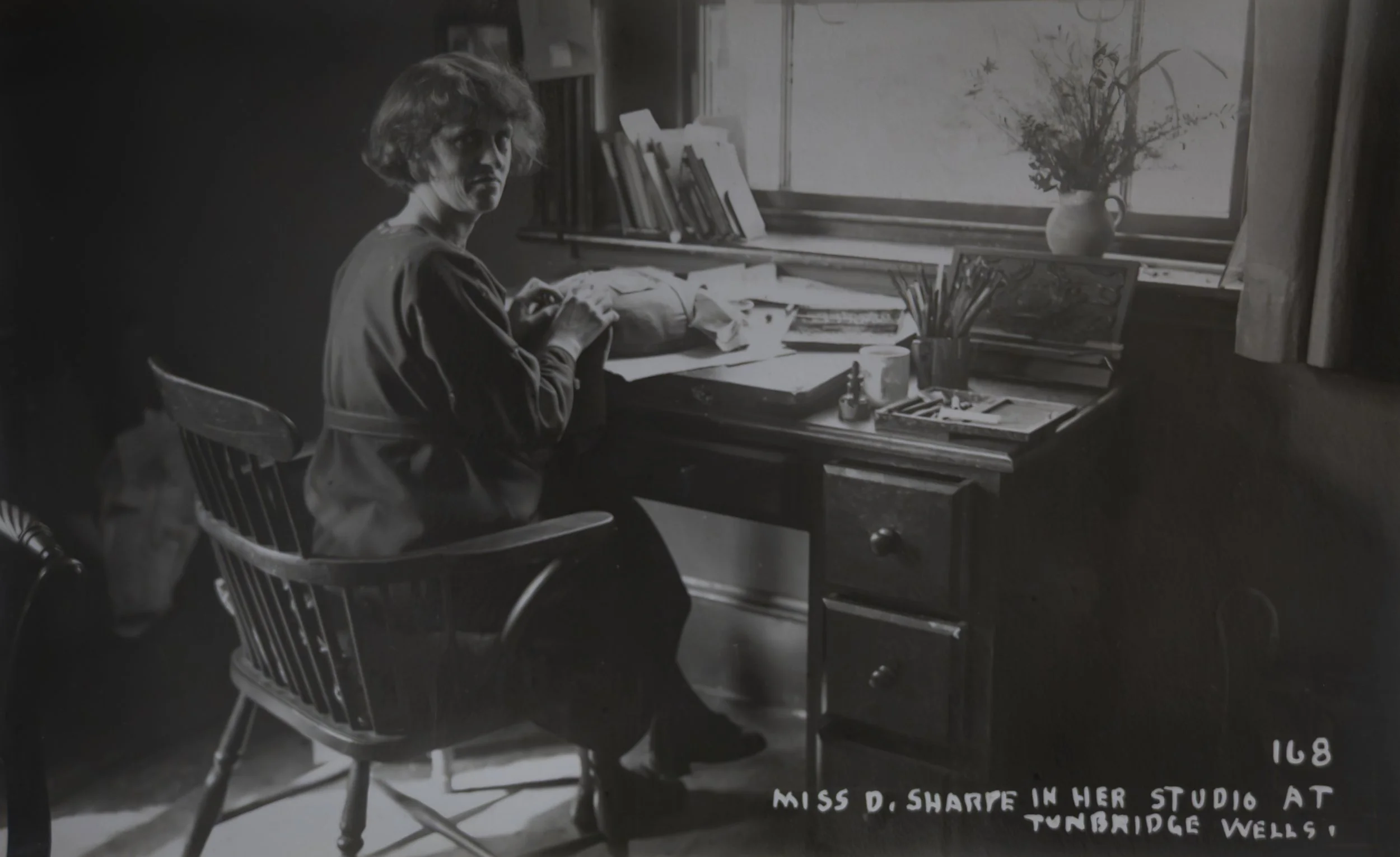
Miss D. Sharpe in her studio at Tunbridge Wells.
While George was a primarily a ‘documentary’ photographer not an artist, his best works show an excellent technique for composition and light.
In this portrait of artist Miss D. Sharpe in her Tunbridge Wells studio, he uses a combination of natural light falling from the window along with what appears to be a rear artificial light. George directs Miss Sharpe to glance over her shoulder towards the camera lens, so the light gently falls on either side of her face. The resulting image has the chiaroscuro aesthetic of a formal portrait with the informal spontaneity of Miss Sharpe momentarily glancing at the viewer.
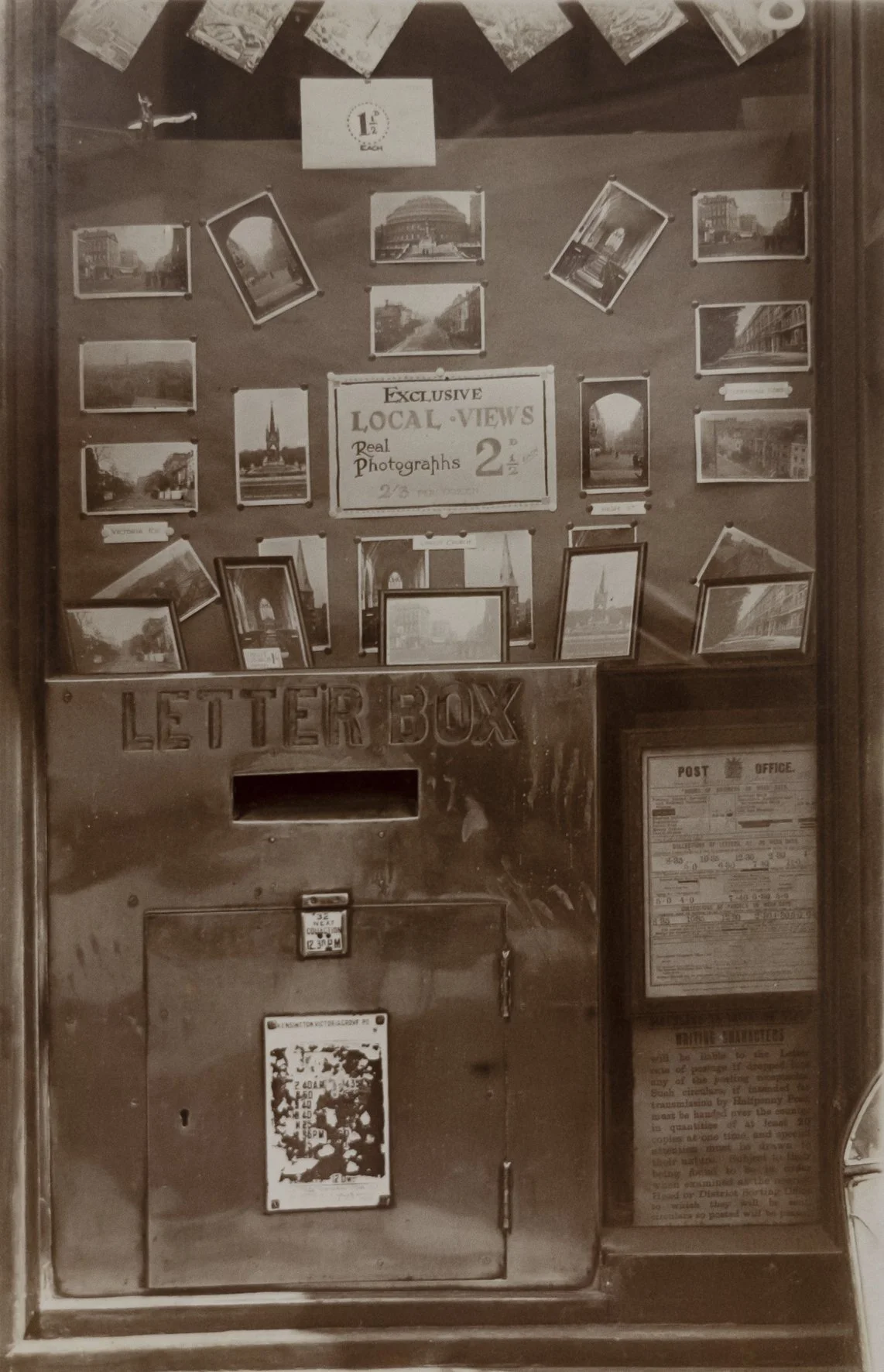
Shopwindow with display of George’s postcards.
Did George make any money from his photography? It’s hard to be sure. On the reverse of the above postcard, a handwritten note indicates a London Kensington shop display of photographs by Brooks for sale at two pence each. The images show ‘local views’ such as Hyde Park and the Royal Albert Hall. Did George do something similar in his home city of York, and perhaps other cities? Did this subsidise his passion for photographing deaf people? He may have kept his hand in cabinet making to help pay the bills?
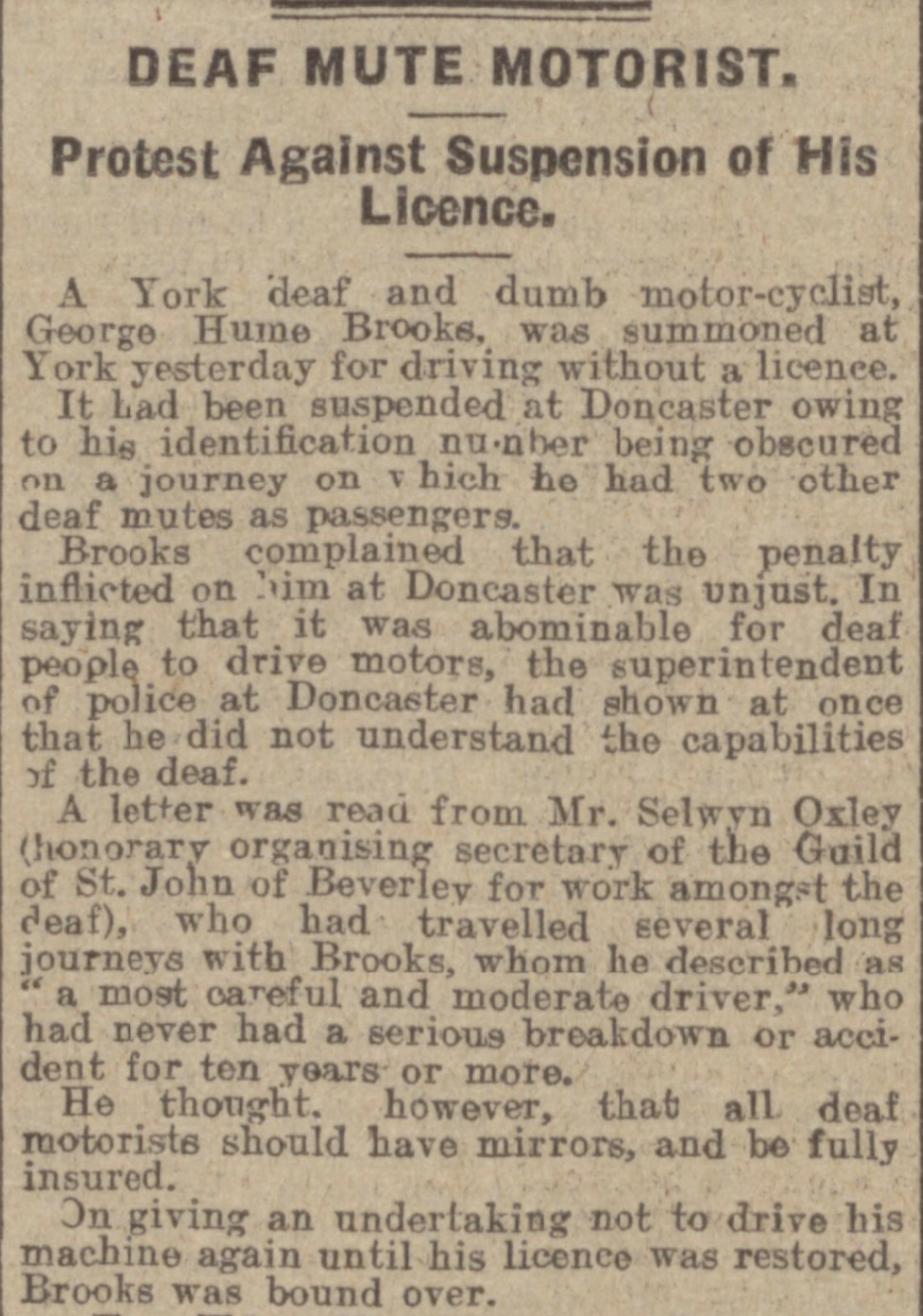
George protests the suspension of his motorcycle license, Leeds Mercury 4 June 1926
In 1926, a Doncaster judge suspended George from using his motorcycle - a move that could have crippled his photography business. He had been stopped by a policeman for not having an up to date license.
George protests local police attitudes
On 3 June, George appealed at York County Court to overturn the initial verdict for being too harsh. He protested that the local police superintendent had unfairly swayed the judge against him by remarking that it was “abominable” for deaf people to even drive motors.
In his defence, Selwyn Oxley wrote a letter of support that he had travelled several long journeys with George and described him as ‘a careful and moderate driver who had never had a serious breakdown or accident for more than ten years’. A compromise was reached, the judge allowing that George could ride again once he had paid for his license renewal.
It’s a revealing case indicating how deaf people at the time faced hearing society’s prejudices about their abilities to drive and travel independently.
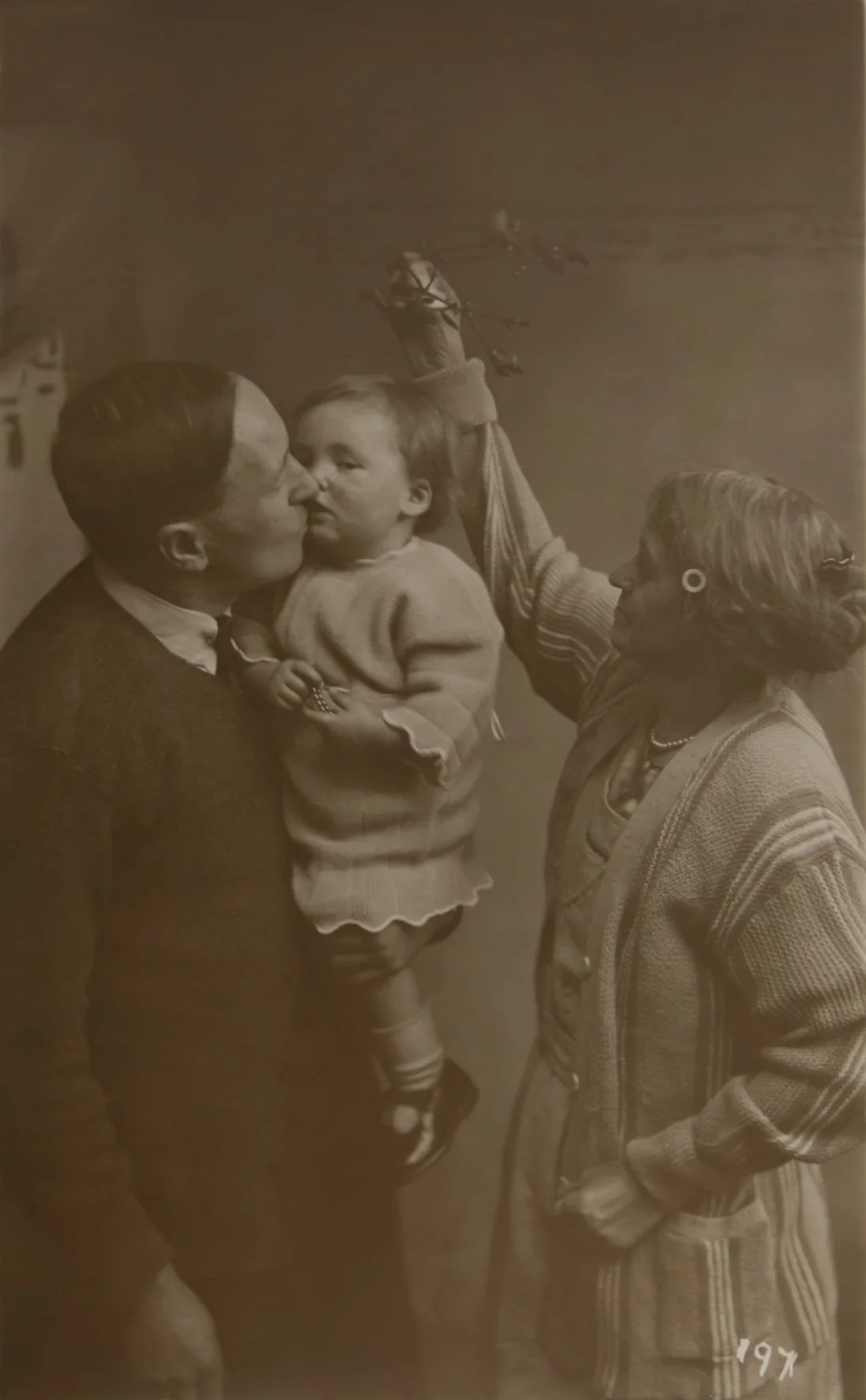
At home, under the mistletoe
George frequently used a self-timer on his camera to pose in front of the lens. Above is touching family portrait of George with his wife, Mary L. Brooks, under the mistletoe with possibly their son George D. Brooks. It’s one of the most intimate vintage deaf photographs I’ve seen.
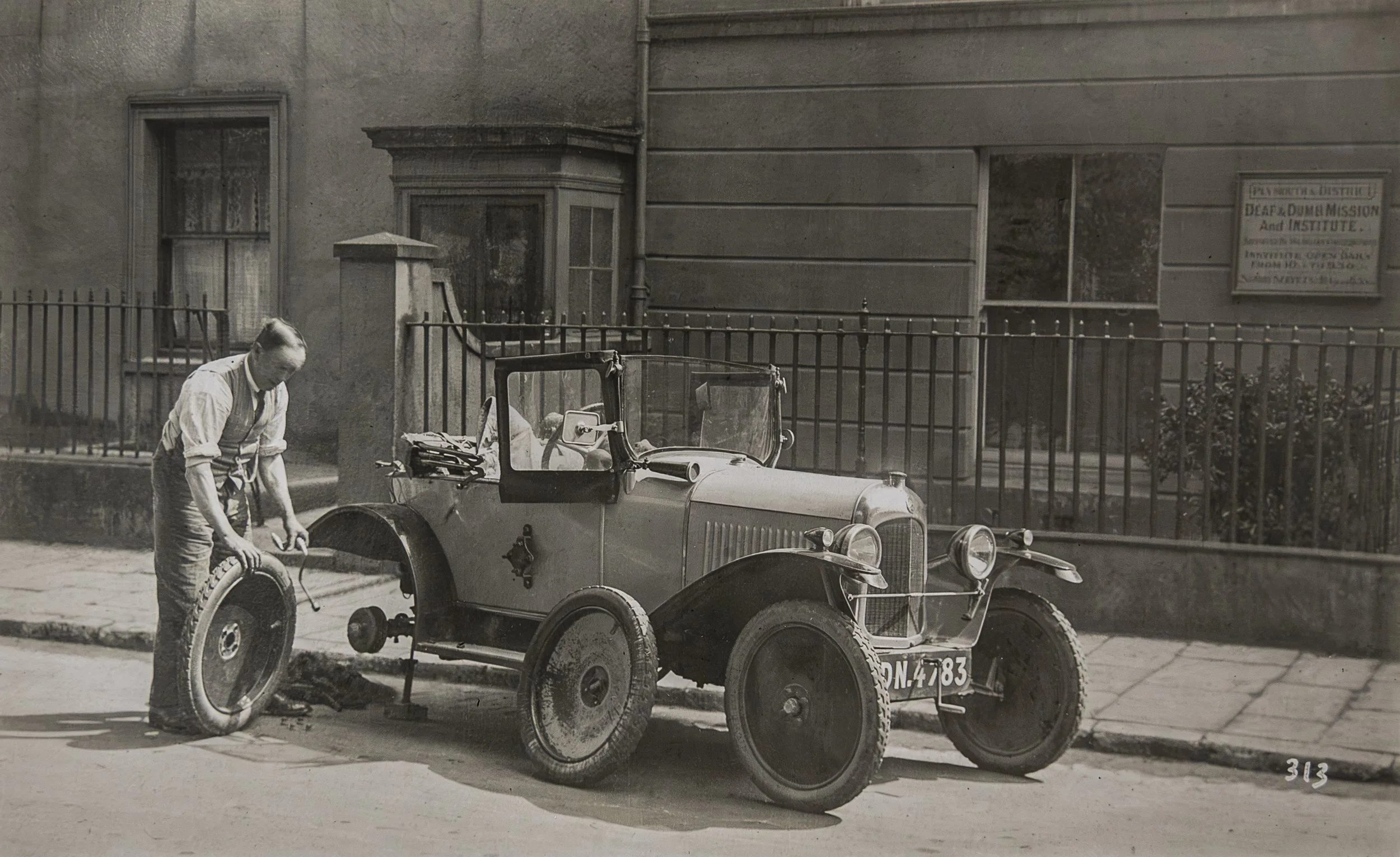
For now, I’ll pause this blog with a photo of George in his latter years where he appears with a convertible Citroen car. Perhaps this was to enable him to make his cross country visits in greater comfort? Here we see him changing a wheel outside the Plymouth & District Deaf and Dumb Mission.
George’s future legacy
We don’t have access to written diaries of George’s thoughts. There’s no record of any exhibitions in his lifetime. The postcard collection at University College London Library likely represents just a fraction of George’s lifetime work.
And yet, George Hume Brooks is one of the most important historic British deaf photographers that we know of. And, it’s my mission to get his work wider exposure.
________________
This is an ongoing research project. I’ll add more photos and biographical details here as and when new ones emerge. The author welcomes correspondence about this story.
________________
Note: all photographs made by George Hume Brooks before his death in 1936 and in the public domain. Under the 1911 Copyright Act (which governs photographs taken before 1957), and subsequent UK and EU legislation, copyright for photographs, including those used on postcards, lasts for 50 years from the end of the calendar year the original negative was made.
______________
References
‘Who was Selwyn Oxley?’, Peter Jackson, Deaf History Journal, Vol 28 Issue 2
‘Deaf Perspectives, Past and Present’, Hannah Salisbury
1889 Yorkshire Institute for Deaf and Dumb, school enrolment rolls
1911 and 1921 census
Leeds Mercury, 4 June 1926
1936 probate for George Hume Brooks
1939 Register for Mary L Brooks
Thanks to Adam Walker (for identifying the Triumph SD motorcycle) and Roger Armstrong (Citroen Cloverleaf).